White Paper
A Letter to the Guest We Forgot
On restoring hospitality to its only true purpose. A midnight conversation. An unintentional metaphor. A problem the industry has been too comfortable not to solve.
Preface
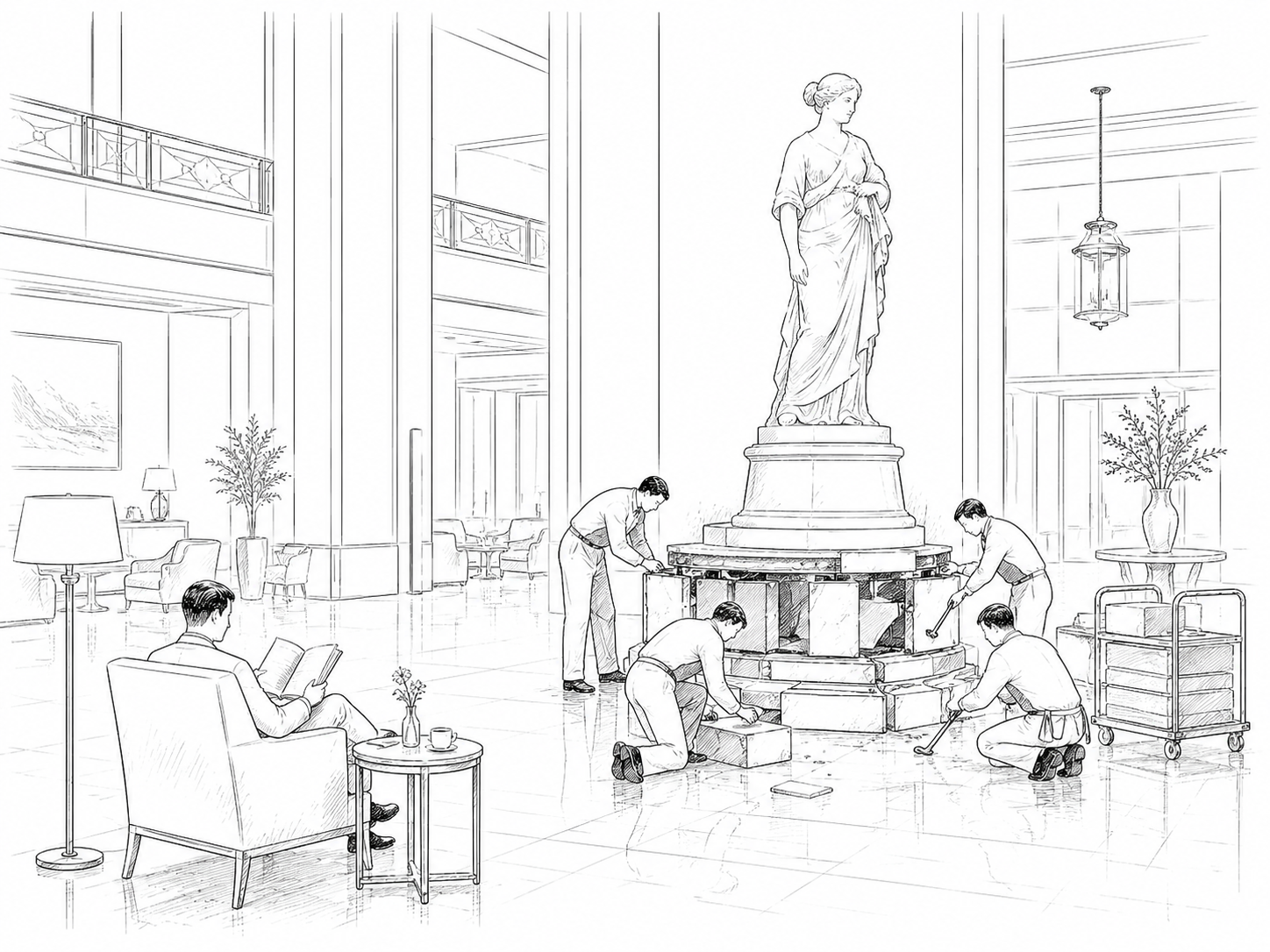
Nowadays, people in the business are too busy praising the statue as a symbol of ritual rather than focusing on the quality of what they are actually paying for. And to teach people a new religion, you must first destroy the statue, forcing them to stop seeing the statue as the center of their worship.
This paper was not planned. It arrived the way certain truths do, sideways, in the middle of the night, when exhaustion drops the filters and the real problems finally agree to be named.
What began as a conversation about business process ended somewhere far older. It became a conversation about idolatry. About what happens when the tools we build to serve a purpose quietly become the purpose themselves. About an industry that once understood, in its bones, that its entire reason for existing was the human being who walked through its door, and somewhere along the way forgot.
The metaphor that emerged was religious because the problem is religious in nature. Not in any sectarian sense. But in the sense that what we are describing is the substitution of ritual for meaning. The worship of the medium instead of the message. The statue instead of the god.
This paper is the attempt to name the statue clearly enough that people stop bowing to it.
I. The Crisis of Mediation
When the channel became the relationship
Every tool the hospitality industry built was designed as a bridge. The property management system. The loyalty program. The channel manager. The check-in ritual. All of it was infrastructure. All of it was supposed to be in service of one thing: a human being arriving somewhere unfamiliar, hoping to be received.
At some point the bridge became the destination.
Hotels now know a guest through their booking ID. Through their tier status. Through the date of their last transaction. The PMS is full of information and empty of understanding. The guest stands at the desk and the staff member looks at a screen, and between them rises something invisible and enormous, made of every system that was built to bring them closer.
The metric that became the mission
RevPAR. Occupancy percentage. Average daily rate. Channel mix. These were invented as shortcuts. Proxies for something harder to measure, which is whether a guest experienced something worth experiencing.
Somewhere along the way, the shortcut became the destination. The proxy became the goal.
Somewhere a revenue manager closes his laptop satisfied. The guest whose name he never learned checks out quietly in the morning. Both of them move on. Neither knows what almost happened.
The hotel that removed its people
Japan built hotels without staff. Not as an experiment. As a conclusion. The logical end of decades of optimizing human interaction out of the guest experience, on the theory that human interaction was inefficiency.
What they discovered, at some cost, is that the inefficiency was the product. The unexpected conversation at check-in. The staff member who noticed a guest looking lost and said something. The moment of genuine recognition between two strangers that no algorithm has yet learned to manufacture.
That is not waste. That is the entire reason a hotel is worth more than a room.
II. The Loyalty Ledger
The closed loop that never touches life
There is a guest sitting alone at a table. On the table is a small birthday cake the hotel sent automatically because the system knew the date. The cake has a candle. Nobody lit it. The guest looks at it the way you look at something that tried but didn’t quite understand you.
This is what loyalty programs have become. The conversion of human faithfulness into a ledger. Points accumulated. Points redeemed. Tier status maintained. A relationship conducted entirely in the language of accounting, between two parties who have never actually met.
The guest feels valued because the number went up. The hotel believes the guest is engaged because redemption rate is up. Nobody asked whether the guest wanted to come back, or whether they felt financially trapped by sunk-cost miles and the faint hope of an upgrade they never receive.
The nation as the business unit
Most hotel operators in emerging markets are not, in any meaningful sense, running a business. They are operating a toll booth on a road the government built. Tourism arrives because a government reformed its visa policy, or built an airport, or paid for a campaign. The hotel’s job is simply to not fail badly enough to lose the booking to the property next door.
This is not a criticism. It is a structural observation. And its consequence is devastating: it removes the incentive to develop any real capability to understand whether a guest left more whole than they arrived.
Why measure guest outcome when arrivals are driven by factors entirely outside your control? Why build the infrastructure of human understanding when the infrastructure of room supply is sufficient?
Because the moment guests have genuine choice, which they increasingly do, the entire architecture is pointing the wrong direction.
III. Destroying the Statue
What the reformers actually understood
The purpose of destroying a statue is not destruction. It is reorientation. The statue was never meant to be the center of worship. It was a medium. A point of focus toward something that could not be looked at directly.
When the medium calcifies into ritual, when the tool becomes the purpose, the only corrective is to remove it. Not with anger. With grief, if anything. Because the statue was once beautiful and sincere. But something more sincere is being obscured by it.
In hospitality, the statue is the metric. The ritual is the morning standup about pickup. The prayer is the budget deck. The congregation is the revenue management team, gathered to discuss numbers that describe the shadow of what the industry is supposed to be.
The reformation does not begin at the Vatican. It begins with one person who names the thing clearly enough that others recognise it too.
The new liturgy
To replace a religion you need more than critique. You need something to practice. The new liturgy of hospitality requires three things the industry has never built in any standardized form.
Intent capture: understanding why a guest actually came. Not their booking channel. Not their previous stay history. Their human purpose. What they were hoping this place would give them.
Outcome measurement: measuring whether that purpose was fulfilled. Not a score from one to ten on a form they fill in while their taxi is waiting. A genuine signal, gathered with care, about whether something real happened for this person.
Incentive realignment: rewarding the people inside the hotel based on the quality of that outcome. Not on occupancy. Not on compliance with brand standards. On whether a guest left better than they arrived.
Everything else is in service of these three things. The technology. The organizational structure. The financial model. The data architecture. None of it is the point. All of it is the medium.
IV. The Servant Problem
The person reading the letter on the stairs
There is a hotel worker sitting on a staircase. The shift is not over but there is a moment, and they have taken it. Shoes off. Reading a letter from home. Around them, the grand architecture of the hotel continues indifferently. The high ceilings. The ornate railings. The lobby below, polished and impersonal.
The grandeur and the human, side by side. Neither acknowledging the other.
This is not a metaphor about injustice. It is a metaphor about invisibility. The hospitality workforce has been economically and socially positioned at the base of the industry that depends on it, and the industry has largely treated this as a natural condition rather than a structural choice.
The economics of anxiety
When occupancy is high, service charge flows. When occupancy falls, for reasons entirely outside any individual staff member’s control, the income evaporates. Same skill. Same effort. Same person. Radically different take-home pay depending on whether a government changed a visa rule or a pandemic happened or the season turned.
The primary career strategy available to a hospitality worker is to move laterally between hotels. Accept a marginally higher salary. Perform structurally identical work in an identical environment. Repeat until promotion arrives or doesn’t.
The industry extracts considerable value from human capability while investing almost nothing in its development or its stability.
A third dimension
There are currently two paths in a hospitality career. Vertical, waiting for someone above to leave. Lateral, moving between properties for incremental gains.
A third dimension is possible. Growth by expanding your deployment radius. By accumulating experience across properties that no single-property career can provide. By building a professional record so rich and specific that it cannot be replicated by someone who stayed in one place.
This is not the gig economy. The crucial distinction is that the flexibility lives inside formal employment protection, not instead of it. The home property remains the base. The network expands the surface.
V. The Internal Labor Network
The constellation
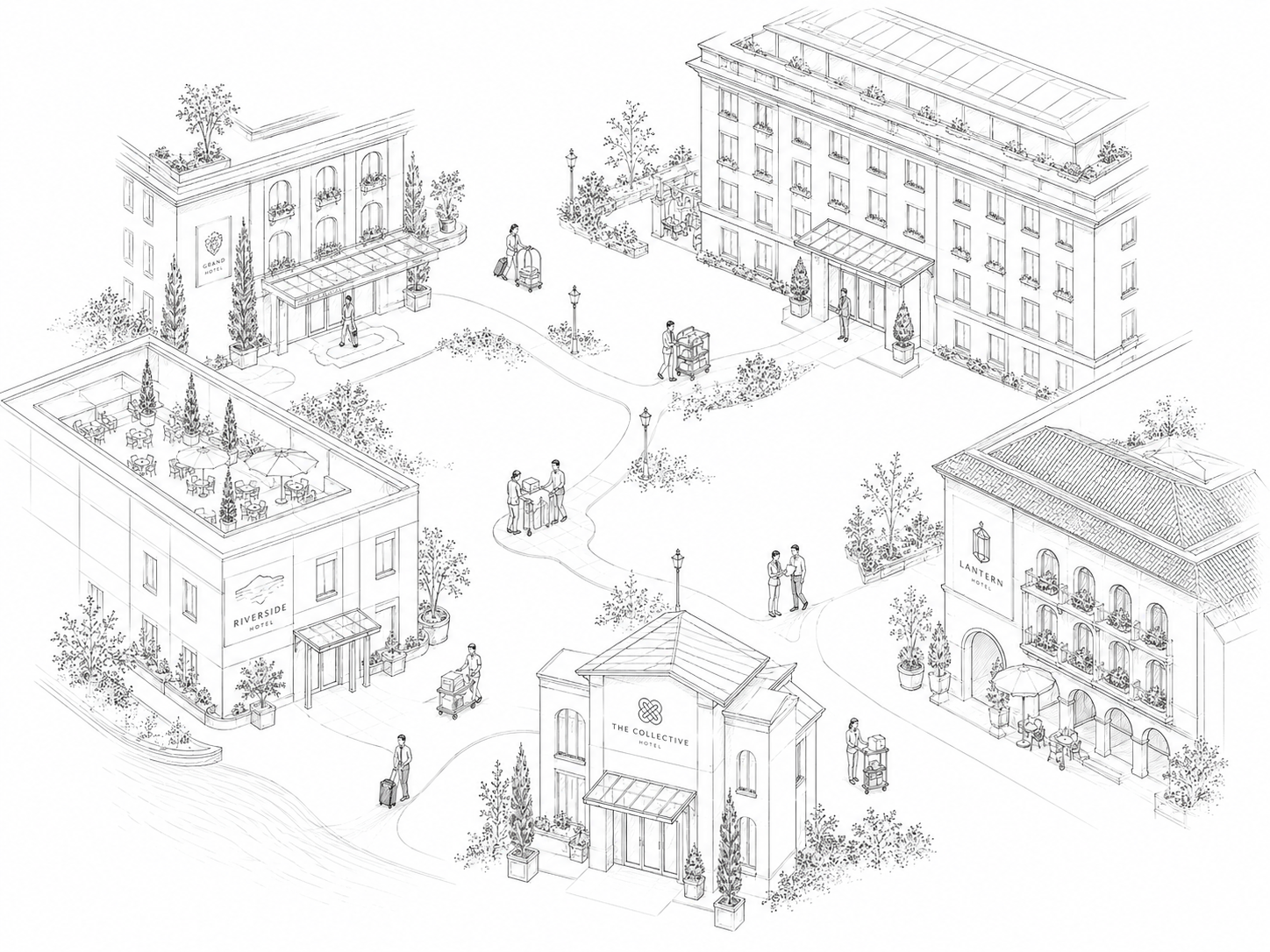
Imagine looking down at a city at night from above. The hotel properties of a single operator glow like stars in a constellation. What connects them now are roads and contracts and occasional transfers. What could connect them are people, moving between them with purpose, carrying their history, contributing wherever the need is greatest, returning to where they belong.
A housekeeping staff member works a morning shift at their home property. In the afternoon, a sister property has high occupancy and not enough hands. She accepts the assignment. Not because she was told to. Because her pocket will be deeper for it, and her professional record will be richer, and the work is there to be done.
No idle staff. No scrambled daily workers hired at the last minute with no institutional knowledge and no stake in the outcome. No forced unpaid leave when the low season arrives. The network absorbs the volatility that the single property cannot.
The financial architecture
The service charge question answers itself once the framework is clear. The home property pays base salary at all times. The receiving property pays a deployment fee, the cost of accessing skilled labor without carrying its permanent obligations. Service charge from the receiving property flows proportionally to whoever worked the shift that generated it.
For ownership groups, what this represents is the conversion of a fixed labor cost structure into a semi-variable one, without dismantling the worker protections that fixed structures were built to provide. This is not a loophole. It is what the framework was always capable of, had anyone thought to use it this way.
The Employee Identity Document
At the center of the network is the EID. A portable professional passport that belongs to the staff member, not the hotel. It travels with them. It accumulates. It cannot be taken away when they leave a property because it was never the property’s to hold.
The EID contains the working history across every property, with verified timestamps. The guest feedback tied to specific service moments. The skill certifications earned in practice, not only in training rooms. The deployment record that tells the story of someone who has worked across six properties in three cities and understands the operational texture of each.
When the staff member with the richest EID is also among the highest earners in the network, the cultural framing changes without anyone having to announce it. The deployment offer becomes something to compete for, not something to fear.
VI. ESG as the New Currency
Planting something in the marble
Two people kneeling on a grand marble floor. One in uniform. One a guest. Between them, growing from a crack in the cold stone, something small and alive. They are not looking at each other. They are both looking at the thing growing between them.
This is what ESG could be in hospitality, if the industry chose to take it seriously rather than reporting it. Not a compliance framework. Not a communications strategy. A genuine shared investment in whether the humans inside a hotel, on both sides of the transaction, leave better than they arrived.
The current ESG conversation in hospitality measures inputs. Energy consumed. Waste produced. Diversity ratios achieved. These are the same category of mistake as RevPAR. Proxies for outcomes that no one has yet agreed to measure.
What to measure
The resilience of the people who show up every day. How much does a staff member’s monthly income vary across a year? The model proposed here should compress that variance measurably against the industry baseline. How many people are separated from employment during low season? Not transferred. Not redeployed. Sent home. That number should trend toward zero. How fast does a staff member’s compensation and complexity of work grow over three years, compared to a peer who stayed in a single property?
The quality of what the guest actually experienced. Did the guest achieve the purpose they came for? Not a score. A signal. Gathered with care at departure, synthesized over time, honest about what it found. When a guest returns, is it because of price or because of experience? These are completely different facts about the hotel and currently no one separates them. Which moments were memorable, and who made them? The human attribution of exceptional experience is the most valuable signal in the industry and the least tracked.
The sustainability of the business itself. Labor cost as a percentage of revenue, and how much that percentage moves month to month. The model reduces both the average and the variance. The ratio of network-deployed staff to externally sourced daily workers. As it shifts, the operator is building permanent human capital rather than consuming disposable labor.
When these measurements are real, auditable, and improving over time, they become a financial instrument. The ESG score improves the refinancing terms. It opens the door to brand partnerships that require it. It makes the asset more attractive to the investors who are beginning to price this risk.
The humanity and the returns are the same thing. They always were.
VII. Impeaching the Status Quo
The question that cannot be unanswered
There is a long hotel corridor. Doors on both sides, stretching into the distance. One door at the far end is open. Light spills through it and reaches across the floor, arriving at the feet of a figure standing halfway down.
The light is at their feet. It has not yet reached their face.
This is the moment before the decision. Not dramatic. Quiet. The figure is neither walking nor standing still. They came from somewhere. There is somewhere to go. The question is whether the light is invitation enough.
Making the question unavoidable
The strategy is not to convince the decision influencers. It is to make their resistance progressively irrelevant. One full conversion. One proof-of-concept property that runs the complete model, measures everything honestly, and produces numbers that cannot be argued with. Then another. The statues do not need to be pushed. They only need to be asked to speak. And when they cannot, people already know what to do.
The people who will decide
The owner. The easiest conversion, approached correctly. Do not lead with the philosophy. Lead with what changes on the P&L. PTEB exposure becomes semi-variable. Low-season labor cost drops. ESG score improves refinancing terms. Brand partnership eligibility expands. The owner does not need to believe in the model to adopt it. They need to see that it performs.
The general manager and department heads. The hardest. Their expertise is in managing the current system. The model does not remove their expertise. It transforms what expertise means. The ones who survive are the ones who become network orchestrators, who understand that their role is not to control a fixed headcount but to connect the right people with the right need at the right moment. Find the two or three in every organization who are already frustrated with how things work. They exist everywhere. Give them the model first. Let the visible outcomes do the converting.
The staff. They will self-select faster than anyone predicts. But only if the first cohort wins visibly. The first staff members who adopt the EID and accept cross-property deployment need to earn noticeably more within ninety days. Not eventually. Within ninety days. That is the only argument that matters in this conversation.
The hidden blocker. The HR manager and the training department sit at the exact intersection of labor law compliance, culture, and staff communication. They can quietly kill a model like this at the implementation level without ever formally opposing it. Give them a larger job, not a smaller one. The HR manager becomes the EID custodian. The network orchestrator. The ESG measurement lead. The person whose function expands to become central to the new model rather than obsolete to it. Otherwise they will protect the statue harder than anyone, because the statue is the only thing that keeps them relevant.
VIII. Passing Each Other on a Narrow Bridge
The frictions, addressed honestly
Two figures on a narrow bridge. Both carrying things. Both needing to get across. One of them has stopped and offered to hold the other’s burden for a moment so they can both pass. An act of practical tenderness.
This is what resolving the frictions of this model actually requires. Not cleverness. Practical tenderness. A willingness to hold the complexity for a moment so everyone can get across.
On labor law
Indonesian labor law establishes employment with a specific legal entity. The model resolves this through the task force precedent already embedded in the regulation. Hotels are permitted to produce services externally. The home property remains the employer of record at all times, bearing full liability as a component of staff benefits.
Staff are not employed by properties. They are employed by operators who deploy them across properties. Several large Indonesian hotel groups already approximate this structure informally. What is being proposed here is to formalize it, dignify it, and make it work for the people inside it.
On the PTEB question
The PTEB account does not need regulatory change to become more dynamic. It needs accounting discipline and clear inter-entity agreement structures within the operating group. Base salary shared across properties based on actual deployment hours. Service charge allocated proportionally from receiving property pools. Deployment fees creating a transparent cost flow that the numbers can follow.
The finance people who are uncomfortable with this discomfort are correct to feel it. The model asks them to do something harder than typing in a spreadsheet. It asks them to model a system where labor cost actually tracks with the business it supports. That is more honest work than the current model requires.
On culture
Culture is defined by repetitive perception. The perception changes when the visible outcomes change. The staff member who accepted the deployment assignment and came back with more money is the argument. The staff member whose EID now shows six properties and twelve skills is the argument.
No force exists in this model. Deployment is staff submission. The person who gets the offer is the person the network has decided is worth deploying. That is not punishment. That is recognition. And people know the difference.
IX. The Letter, Read Aloud
The lobby again. Same chandelier. Same marble floor. Same desk in the corner.
But now the chair is occupied. The guest is seated, holding an open letter in their hands. And the woman who stood at the window, her back to the room, writing something she was not sure she would send, has turned.
She is reading it aloud.
The candle on the desk is lit.
This is what the industry has always been capable of and has rarely chosen to be. Not the delivery of a room at a price that beats the one next door. Not the accumulation of points toward a status that confers nothing except the feeling of being slightly less anonymous. Not the frictionless transaction optimized until the human is gone from it.
A letter, written with care, read to someone who arrived hoping to be received.
The servant becomes a network professional. The guest becomes the center of daily practice again. The industry discovers that its most sustainable asset was never the real estate. It was always the people.
The hospitality industry does not have a technology problem. It does not have a labor efficiency problem. It has a meaning problem. It built rituals so elaborate that the rituals became the purpose. It measured proxies so long that the proxies became the goals.
Restoring meaning requires what every reformation requires. The courage to name the statue for what it is. The willingness to stop bowing to it. And the discipline to build something in its place that actually connects the practitioner to the thing that was always the point.
In hospitality, that thing is the guest. It was always the guest. Every piece of infrastructure, every metric, every role in the organization exists, or should exist, as a form of communication between the hotel and the human being who chose to trust it with a portion of their life.